











Thus far, Prime Minister Andy Burnham’s premiership has been characterised by a series of somewhat piecemeal announcements, from ending rough sleeping to requiring companies to include salaries on job adverts. Welcome initiatives, certainly, but not ones that help form a clear picture of what the Burnham era ultimately aims to achieve.
On devolution, however, the direction of travel is much clearer. As the former Mayor of Greater Manchester, Burnham has brought to Number10 many of the frustrations he experienced first-hand: powers that stopped short and funding settlements that constrained rather than enabled local ambition. He now has the opportunity and the drive to fix both.
But clear ambition is the easy bit. Delivering it is less straightforward, and the announcements so far leave some big questions open – both for government and the private sector.
A Messy Map
The Government has committed to full devolution coverage by the end of 2028, but places are starting from very different positions and following different routes. At present, areas sit across multiple “stages” of devolution, from applying to become a Foundation Strategic Authority, as in Gloucestershire, to operating as an Established Mayoral Strategic Authority, as in Greater London or the North East of England.
Crucially, there is no single, standard route between these stages. How places move from one model to the next, at what pace and against what criteria, remains unclear, which leaves big questions about what the next phase will look like in practice.
Figure One below highlights the current state of play for places across England.
The map is messy. And that’s without the added complexity of local government reorganisation (LGR), which makes fitting a mayoral model onto such different local geographies even harder. But it can be done. Cambridgeshire and Peterborough and the East Midlands show that areas can navigate changing local government structures while continuing to progress their devolution settlements.
But not every place wants to (or can) follow the same path. Opposition to LGR and mayoral governance is apparent in parts of the country, alongside questions about whether the model will deliver for every local economy.
Yet devolution remains one of the few areas where this Government has a clear direction of travel. As long as Burnham remains Prime Minister, it seems unlikely that the remaining gaps on the map will be left unresolved indefinitely.
For places where the future remains uncertain, now is the time to get their ducks in a row, align around a preferred way forward and make the case for it, before any decisions are taken out of their hands.
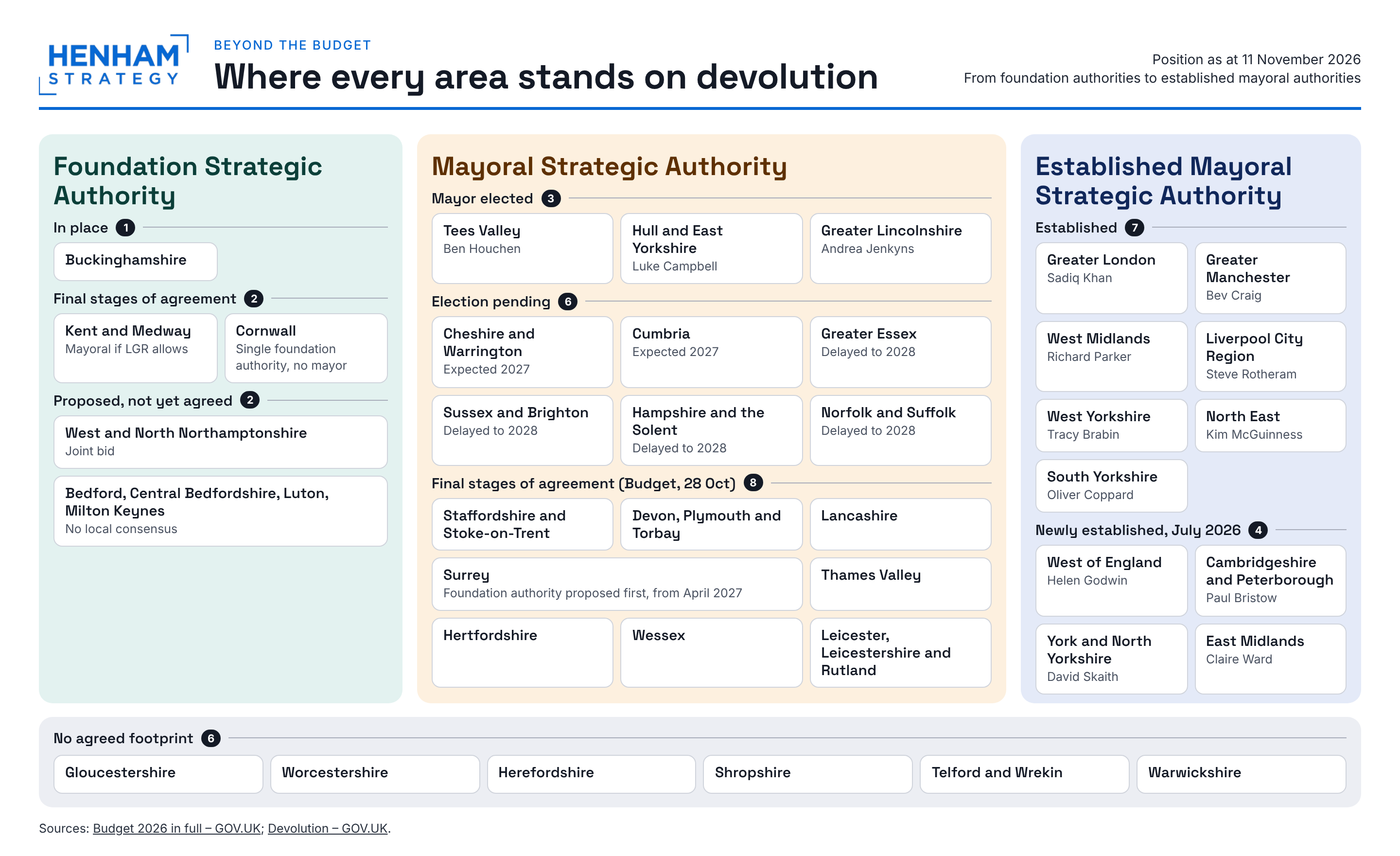
Figure One: English Devolution, the State of Play (11 November 2026)
Winners and Losers
Fiscal devolution is where the Government has been particularly assertive. Fully devolving business rates and giving Mayoral Strategic Authorities (MSAs) a share of income tax gives mayors greater financial autonomy and mark a significant move away from reliance on the grant system. However, giving each MSA a bespoke starting allocation reinforces a longstanding concern about the uneven playing field across English regions.
Will those allocations help bridge the gap between places, or favour areas where the greatest returns can be generated? The Government has not said, but it has indicated that mayors will benefit where revenues outperform the average. Yet faster income tax growth may owe as much to demographics, sector mix and wider economic conditions as to mayoral policy. The risk, therefore, is that a system intended to reward performance instead rewards existing economic advantage.
And with the overall funding envelope unchanged, fiscal devolution looks set to change where the money comes from, not necessarily how much there is. That leaves the Government with a choice: close the gaps between places, or back the places most likely to deliver. It will struggle to do both, and an investor’s logic pulls towards the second.
Levers versus Ambition
Even with the Budget laying the foundations for fiscal devolution, a bigger question remains: will mayors have the powers to match the Prime Minister’s ambitions? For now, the honest answer is that it depends where you live.
The English Devolution and Community Empowerment Act 2026 creates a clear hierarchy of devolution (see Figure 1): Foundation Strategic Authorities can coordinate strategically but have more limited delivery powers, Mayoral Strategic Authorities gain stronger levers over areas such as transport and planning, and Established MSAs can formally ask Government to devolve further powers.
And it seems places towards the top of that hierarchy are already looking for ways to push further. Steve Rotheram, Mayor of the Liverpool City Region, is due to ask the Secretary of State to establish the Liverpool North Docks Mayoral Development Corporation, while the Birmingham East Development Corporation in the West Midlands launched in May 2026. Both are designed as powerful vehicles for regeneration, concentrating planning, land and development powers around a defined area.
That could be transformative for local growth, but not in every postcode. Some of the strongest delivery tools are tied to mayoral governance, meaning places reluctant to adopt a mayor also face a choice: remain outside parts of the emerging devolution settlement, or accept the governance model in return for access to greater powers. Those additional levers may ultimately prove the carrot the Government needs to get more reluctant places on board with Burnham’s ambitions. His forthcoming ten-year plan and the Rewiring the State White Paper should provide greater clarity on how the Government intends to navigate that tension.
The Capability Conundrum
For the most devolved places, however, the challenge is shifting from access to powers to the capability to use them. Turning wider responsibilities and more flexible funding into delivery at scale will require significant capacity and expertise, from commercial investment and major-project delivery to transport, skills, data and evaluation.
The Government has recognised the scale of the challenge, with an MSA capability assessment trailed in the October Budget2026. Moving more civil servants out of Whitehall is just one of the interventions being used to try to close the critical gaps, but decentralising power is one thing; decentralising capability is another. Building it locally will take years, particularly as he job itself becomes more complex. Mayors are now being asked not simply to spend public money, but to use it to crowd in private investment. That takes a different set of skills, relationships and commercial expertise, none of which can be created overnight.
That makes engagement a capability. The UK’s Modern Industrial Strategy envisages a much stronger partnership between places and the private sector, but if places lack the capacity, commercial expertise or clear routes for engagement to respond, that willingness to partner and invest risks going untapped.
Devolution also creates multiple front doors across England, so organisations will need to know where responsibilities sit, which powers and funding each authority controls, and who to speak to, from the mayor’s office to the investment promotion agencies. Places will need to make that as straightforward as possible: clear front doors, quicker decisions and a visible route from first conversation to delivery.
But the onus will not sit entirely with places. Businesses, investors and other organisations will need to get better at navigating the new landscape too: understanding where decisions are made, building relationships with the right institutions and engaging early enough to shape emerging strategies, investment priorities and programmes rather than waiting for opportunities to come to them. As more economic decision-making moves out of Whitehall, having a clear place-engagement strategy will matter.
From where we sit, the places that make engagement easy will be the ones businesses and investors go to first. Equally, the organisations that understand the new landscape and know how to engage with it will be best placed to make the most of devolution.
What Next?
There’s a lot still to work through. We cannot expect the Government to have all the answers immediately, but as the next phase of devolution takes shape, there are some questions we will be watching particularly closely:
- How will the Government balance its ambition to narrow the gap between places with the need to generate the greatest return from limited public investment?
- Will the offer of more powers be enough to bring reluctant places towards a mayoral model?
- What capabilities will MSAs need to make the most of their new powers, and how quickly can the most significant gaps be filled?
- How can businesses, investors and organisations navigate, or be supported in navigating, this new devolved landscape?
If you want to understand more about devolution, and what it could mean for your business or organisation, join us on 9 December for Henham Strategy’s Inside England’s Devolution Revolution: What You Need to Know webinar.
We’ll be getting into the nuts and bolts of MSAs, what their growing role means in practice and, importantly, how organisations can engage with them effectively. We’ll also be joined by Pete Robbins, Senior Adviser at Henham and former Special Adviser to the Prime Minister and Number 10 Director of Local Government and Devolution, to share his perspective from inside Government.