











John Healey’s first Budget as Chancellor put the machinery of government behind fiscal devolution, housing and the cost of living. Our analysis breaks down the headlines, the politics and the impact on JBP’s sectors.
A distinctly Labour Budget, built for breathing space
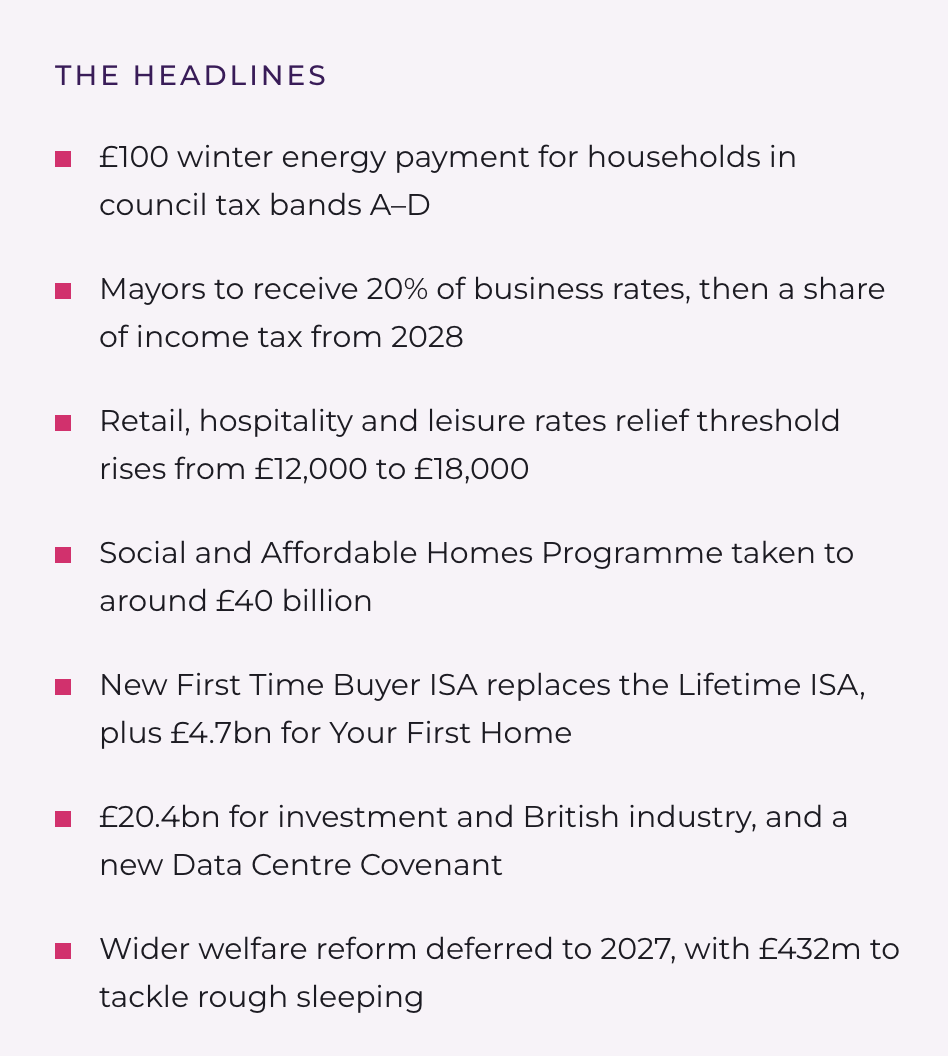 Rather than a spending spree or sweeping tax changes, the Chancellor focused on changing how decisions are made, how investment is directed and how the state operates — devolving greater power and resources to mayors in support of Andy Burnham’s political vision.
With growth downgraded and borrowing higher, Healey accepted a narrower fiscal buffer to give households and businesses immediate relief. The bank surcharge doubling from 3% to 6% raises revenue without touching headline taxes on workers — though some of that cost may yet reach middle-income households.
The big calls on welfare, defence and public spending have been pushed to 2027 and the Spending Review. The test now is whether rewiring government can deliver the growth Labour has promised.
The Political Outlook
A Budget defined by the decisions it avoided
In fairness to the Chancellor, the geopolitical situation has once again dealt the Treasury a difficult hand. Higher energy prices, inflation and borrowing costs have eaten into the fiscal headroom, leaving little room for major spending commitments without difficult decisions elsewhere.
The Chancellor has chosen to absorb much of that pressure rather than impose substantial spending cuts, leaving a Budget characterised by smaller interventions that seek to provide ‘breathing space’. However, the bigger challenge is whether existing spending plans remain credible in the face of sustained inflation.
The Budget’s clearest winners include young people, and mayors. Yet fiscal devolution brings its own challenges. As commentators have warned, without careful design and sufficient local capacity, greater financial autonomy could widen the gap between wealthier regions and those with weaker tax bases. Meanwhile, the Government continues to shift more of the tax burden towards banks, businesses and income derived from assets, an approach that may appeal to Labour’s left but carries its own questions about investment and the eventual cost to consumers.
Ultimately, this was a Budget defined as much by the difficult decisions Healey avoided as those he made. The big questions on welfare reform have been kicked into next year, while the tougher choices on defence and public spending have been left for the Spending Review. The Government has made the cost of living its central political battleground, but that is a risky strategy when global events can quickly wipe out any relief the Treasury offers.
The Chancellor has bought the Government some breathing space. The question now is whether the PM can use it to deliver before voters start asking where the change they were promised has gone.
Transport & Logistics
The Budget offers transport and logistics businesses immediate relief from operating costs, with the 5p fuel duty cut and freeze extended to 1 July 2027 alongside the existing HGV road tax holiday. The extension of the red diesel duty cut also supports rail freight and other eligible users. For operators facing high fuel prices and tight margins, these measures provide breathing space and greater certainty over near-term costs. However, they postpone increases rather than establish a lasting settlement, leaving businesses exposed to another cost adjustment next July.
The longer-term picture is less straightforward for fleet investment. The mileage-based charge for electric and plug-in hybrid cars from April 2028 will change running-cost calculations for company car fleets, although it does not extend to vans or HGVs under the proposals outlined. Automated reporting and refunds could ease administration, but operators still need the promised guidance. Support to reduce public charging costs is welcome, although retaining 20% VAT on public and workplace charging limits the benefit for users unable to recover it. Scheduled increases in vehicle and benefit taxes will also offset some of the wider relief.
For the sector, the package provides more certainty over the next fuel bill than the next investment decision. The measures outlined offer less detail on depot charging, grid connections, freight infrastructure and support for decarbonising heavy vehicles. Heathrow expansion could strengthen international connectivity and cargo capacity, but a further update on the consultation provides no firm delivery timetable. The central gap remains a clear connection between temporary cost support and the infrastructure needed to improve productivity and enable fleet transition.
Planning and development
The Budget offers housebuilders, developers and planners a combination of support for buyers, additional affordable housing funding and greater regulatory certainty. The £1.5 billion uplift for the Social and Affordable Homes Programme, intended to deliver around 10,000 additional homes, sits alongside cheaper council borrowing and VAT relief on qualifying land transactions involving social housing providers. These measures could help unlock mixed-tenure developments, while the £4.7 billion Your First Home scheme aims to support 70,000 first-time buyers and strengthen sales. Proposed brownfield Biodiversity Net Gain exemptions could also improve viability on smaller sites. Together, the measures recognise that planning permissions alone will not deliver homes unless schemes are viable and buyers can afford them, although questions remain over how much additional purchasing power will translate into new supply.
The commitment to make MHCLG’s PlanAssist AI tool available to all councils in England by the end of 2027 could help reduce routine planning decision times and free officers to focus on complex applications. Requiring key planning documents to be digitised and published as open data should support wider adoption. The potential benefit for developers is faster processing and fewer delays, but the ambition to halve routine decision times should not be read as a promise to halve the determination period for major schemes. AI will not resolve difficult negotiations over viability, infrastructure or design, and its effectiveness will depend on data quality, staff training and councils’ capacity to implement it.
The proposed expansion of development corporations’ access to long-term public finance could also help address barriers to delivery. A pilot for the Greater Cambridge Development Corporation will support land assembly and investment alongside private partners, with a similar approach potentially extended to Oxford. This could be particularly significant for large-scale regeneration and housing-led development, where fragmented ownership and upfront infrastructure costs can delay schemes for years. It points towards a more active public sector role in assembling sites, financing infrastructure and attracting private investment.
However, much of the support will take time to arrive, with details on eligibility, developer contributions and implementation still outstanding. Beyond the targeted development corporation proposals, the measures offer less certainty on infrastructure funding, utility connections, construction skills and planning department capacity, all of which can prevent consented schemes from starting.
Energy and low carbon
Energy was front and centre of the Chancellor’s Budget speech, with a clear commitment to lowering household bills and easing the pressure on families and businesses amid the ongoing energy crisis. This was accompanied by a continued commitment to net zero by 2050, with John Healey recognising clean power as central to delivering cheaper, more secure and resilient energy. Unfortunately for the Chancellor, an otherwise confident performance was interrupted by a potentially revealing slip of the tongue when discussing North Sea oil and gas, appearing to suggest that Energy Secretary Miatta Fahnbulleh had opposed, rather than approved, the decision on Jackdaw. With reports of Cabinet divisions over the future of Rosebank, and Treasury forecasts reportedly assuming revenues from the still-unapproved oilfield, it was a light-hearted moment.
The Chancellor made clear that new generation projects seeking Government backing will need to demonstrate that they can connect to the grid, lower bills and benefit the wider energy system. A new Cost Control Framework, expected at the 2027 Spending Review, will also place greater scrutiny on the costs passed through to consumers. Meanwhile, the extension of the VAT reduction on electricity until July 2027 and a £100 winter energy payment for up to 20 million households in England provide more immediate relief. The Government is also pressing ahead with Great British Grid to remove red tape and improve grid connectivity, reforms to renewable energy contracts and the removal of gas standing charges, although the latter will redistribute rather than simply eliminate the underlying costs.
Affordability is becoming a more explicit test of energy policy, with developers increasingly expected to demonstrate not only their contribution to decarbonisation but also tangible benefits for consumers and the wider economy. The decision to scrap the proposed Gas Shipper Obligation and fund hydrogen projects directly through government illustrates this shift, although future support will remain subject to affordability and value-for-money considerations.
Devolution
The Government’s move towards 10 new devolution agreements, taking coverage to over 90% of England’s population, signals a lasting shift in where decisions affecting development and investment will be made. Eight Mayoral Strategic Authorities are proposed for Devon, Plymouth and Torbay; Hertfordshire; Lancashire; Leicester, Leicestershire and Rutland; Stoke and Staffordshire; Surrey; Thames Valley, covering Oxfordshire, Berkshire and Swindon; and Wessex. Kent and Medway will have either a Mayoral or Foundation Strategic Authority, depending on the outcome of local government reorganisation, while Cornwall will have a single Foundation Strategic Authority.
These bodies will become increasingly important partners in shaping housing, transport and growth priorities, making early engagement with forthcoming consultations worthwhile. More detail on the wider settlement and its implementation is expected in the Devolution White Paper. However, agreements alone will not guarantee the funding, powers or capacity needed to accelerate delivery. With full coverage targeted by the end of 2028, the test is whether this expansion gives investors greater certainty over who can make decisions, fund infrastructure and get projects moving.
Navigate what comes next
From fiscal devolution to the Spending Review, the decisions that affect your organisation are moving. Our public affairs team can help you understand the detail, engage the right decision-makers and position your case.