











This (poorly misquoted) proverb is widely attributed to Roman poet Ovid, the author of Metamorphoses, a poem about transformation. It is fitting that a change maker’s words would inspire not only the name OVID Health (AKA the Health Change Makers), but also our takeaway from Wednesday’s Pharma & Healthcare Comms & Reputation Conference. We left the meeting with the feeling that transformation is a necessity for the pharma and healthcare communications industry.
The most compliant thing to do is often nothing, but where does that leave our clients and the communities they serve? The same place they were yesterday.
If fortune favours the brave, how can our industry be brave?
Tackle misinformation head-on
Misinformation is a real and growing healthcare challenge. Patients are encountering distorted health narratives before even reaching a healthcare professional. According to the Academy of Medical Sciences, 17% of UK adults say they gave been personally affected by misleading health information. In such an environment, it is no wonder four-fifths of GPs have altered a treatment regimen due to the impact of misinformation.
Credible information is losing ground and misinformation is filling the void. The pharmaceutical industry has not only an opportunity, but a responsibility to make accurate health information more accessible and shareable. This means bravely stepping up to the plate in a possibly hostile environment.
Communicate through authentic voices
To tackle misinformation, we need to meet our audiences where they are and communicate through the people who influence them. This could mean expanding our view of credibility and importantly what “influence” actually means.
It is all well and good picking a partner because they appear “credible”. That is, we believe our audience “should” be listening to them. But if our audience isn’t “actually” listening to them, then partnering with them is an exercise in futility. We need to find the people with the social media savviness to say the right thing in the right way, and the authenticity to be heard.
Which also brings us to channel planning, especially on social media. Posting is not the same as participation. Our industry’s unfortunate modus operandi has been to design content around risk avoidance, rather than social exposure: disclaimers at the top of posts, comments sections disabled, partners forced to delete their posts after a set period of time.
We need to stop thinking “what if someone says something negative?” and start thinking “what if someone says something positive?”. By building content and partnerships with this in mind, we can make social media truly social, aligned to the channel it is on and authentically resonating with the people we’re trying to reach.
Invest in long-term partnerships, not short-term projects
It’s easy to understand why one-off partnerships are often the norm. Strategic priorities change, budgets get cut and teams shuffle. Budgets are cyclical as well, meaning there’s no guarantee of a project continuing beyond the pilot or first year of launch.
Unfortunately, one-off partnerships with creators, journalists, patient groups and key opinion leaders continually require brands to rebuild trust from scratch every time. This not only wastes time and money, but also diminishes your brand’s perception among the very people you’re looking to influence.
Pilots should, therefore, be designed as the beginning of longer relationships, not dead ends. This is something we, at OVID Health, often advise our clients when it comes to patient group engagement in the run up to a regulatory milestone. We can’t just partner with key stakeholders when we need something, we have to engage with them, listen to them, hear them, respect them – then, and only then, can we start working towards a shared communications goal.
Watch your tone?
When authenticity is king, having an opinion is vital.
We empower OVID employees to communicate our values and purpose – but also sticking to the areas where we have a clear position. If people expect you to have an opinion on a controversial issue, it becomes less of a political statement when you comment about it.
But even if you’re having an opinion about a controversial geopolitical or challenging healthcare topic, that doesn’t mean we need to speak in a wooden tone. When Lilly tried to tackle the growing challenge of counterfeit medicines, they could have pointed fingers or focused on the serious dangers. Instead, they tested a humorous campaign with a visual creative that showed people in scenarios they shouldn’t be in – highlighting how counterfeit medicines shouldn’t be in your medicines’ cabinet.
The lesson? Having an opinion doesn’t mean sounding opinionated: the strongest communications are clear about what they stand for, but creative enough to make people want to listen.
Be creative, be brave
“I haven’t any courage at all,” said the Cowardly Lion, before ultimately discovering, with a little help from his friends, that the courage was within him all along.
Every company has the potential to be creative and brave. But bravery can’t just live within the communications team. To unlock it, we need to bring the entire cross-functional team along for the ride, especially our colleagues in compliance.
That means involving them at the beginning, not presenting them with a fully formed idea and asking for a yes or no. Share the ambition, bring them into the creative process and work together to understand what is possible, rather than starting with what isn’t.
Then, like the Cowardly Lion, we may discover we were capable of a little more courage all along, and fortune truly favours the brave.
by Will Brennan, Senior Account Director
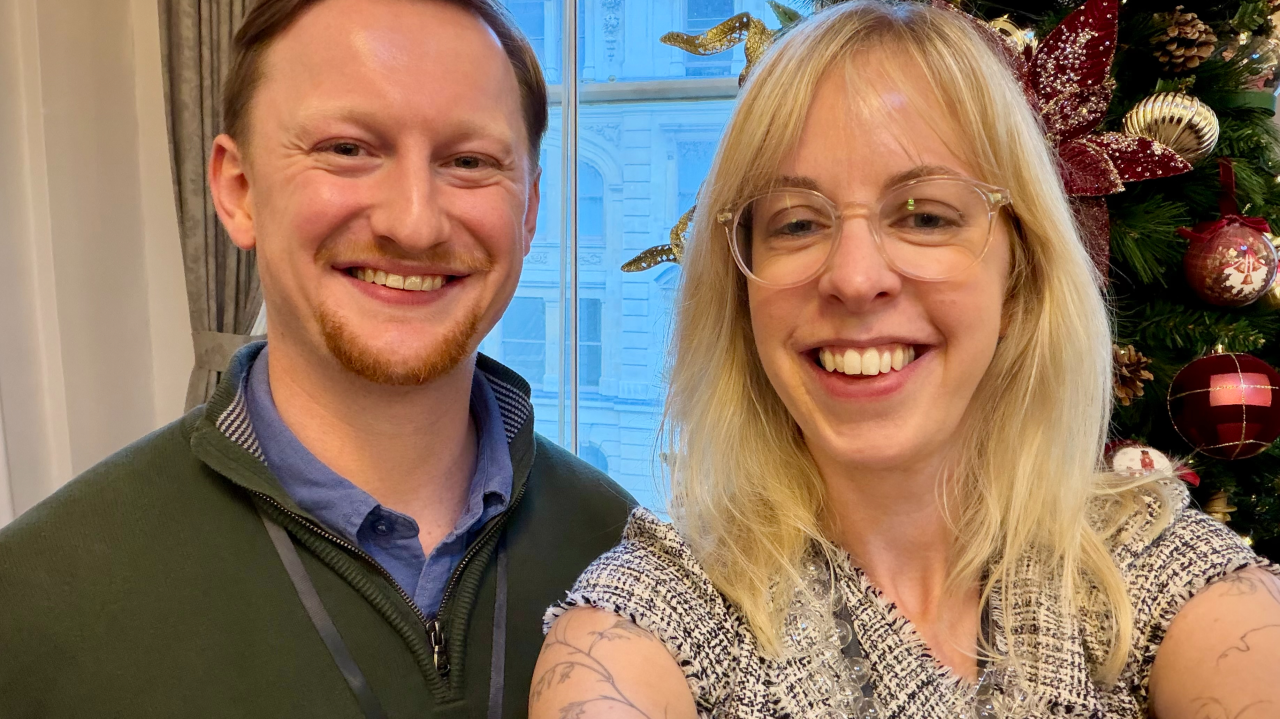
Jenny Ousbey and Will pictured at the Pharma & Healthcare Comms & Reputation Conference