










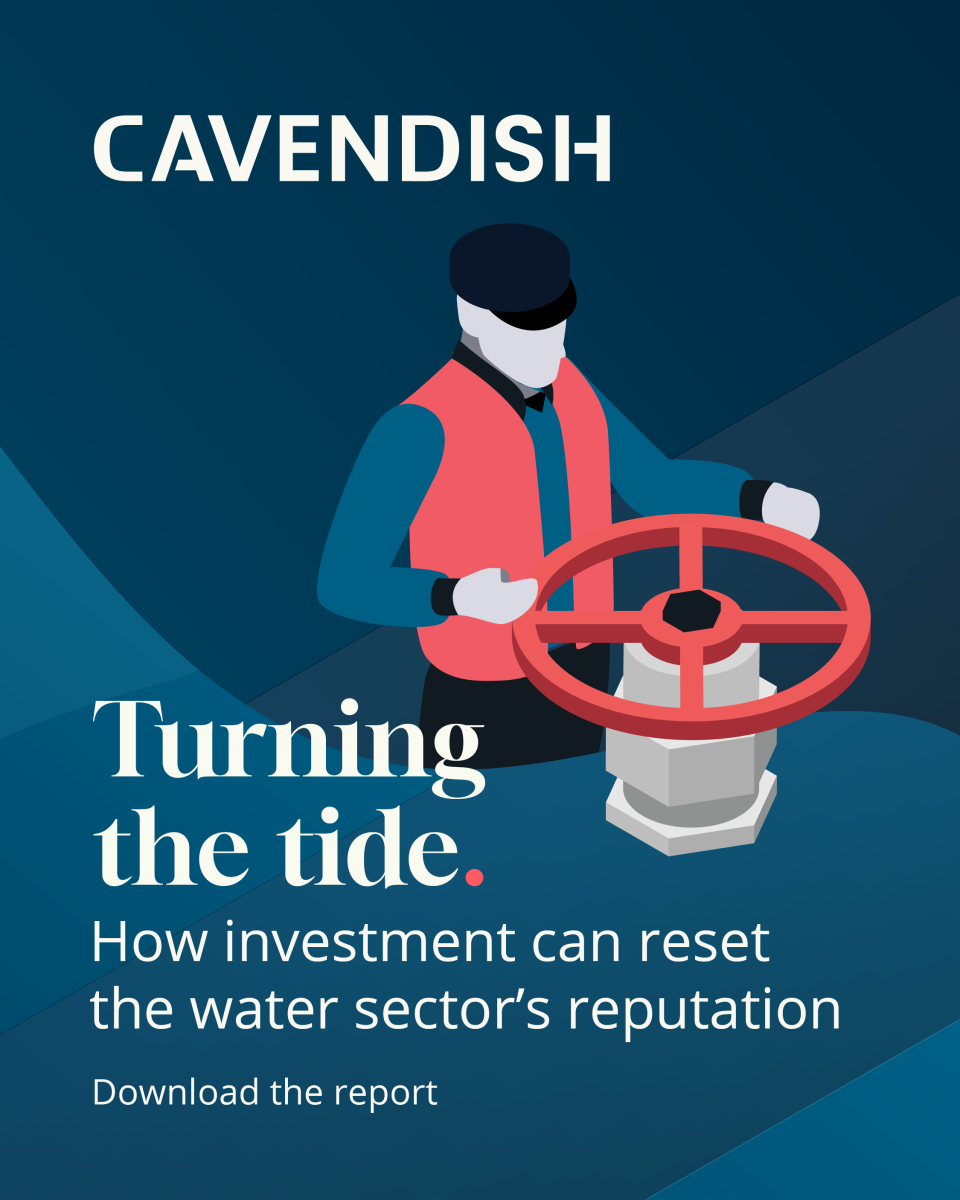
 Cavendish has published a new report based on YouGov polling of more than 6,500 people across Great Britain.
The report reveals a striking contradiction at the heart of public opinion on water. While most people believe the water industry nationally is in trouble, they tend to think their own taps, pipes and rivers are performing better than the wider picture suggests.
The research uses a brand-new polling approach that looks at what customers think about their own water provider, rather than relying solely on general views of the sector. By surveying customers within each provider’sregion, it uncovers sharp differences in perceptions between companies – and between national and local experiences.
The report reveals the contradiction that sits at the heart of a deepening reputational problem for the water sector:
- While half (52%) of the public say water supply and management in the UK is in a bad state, people are consistently more positive about the performance of their own water company and local area;
- Just one in ten people (10%) say they trust water companies to tell the truth about themselves, and even the best performing companies are trusted by fewer than one in five of their own customers – pointing to a systemic credibility problem rather than a handful of bad actors;
- Four in ten people (43%) say pollution should be tackled even if it means higher water bills, underlining the importance of visible environmental progress to rebuilding trust.
These findings land as the industry enters its largest ever investment period, but the research suggests that fixing infrastructure alone will not be enough to immediately address the sector’s reputational challenges.
Download the full report here
Foreword by Paul Horton, Chief Executive, Future Water Association
The UK water sector stands at a defining moment.
Few industries are as fundamental to daily life as water. It underpins public health, environmental protection, economic growth and community resilience. Yet, as this report sets out, the sector’s public standing has rarely been lower. Trust has eroded. Confidence has faltered. And too often the narrative surrounding water companies has been one of failure rather than progress.
The findings presented in ‘Turning the Tide’ are both sobering and instructive.
Just 10% of people trust water companies to provide truthful information about themselves. More than half (52%) believe water supply and management across the UK is in a bad state. Environmental performance - particularly sewage discharge and pollution - dominates public concern, even outweighing anxiety about rising bills. These perceptions are shaping not only reputation, but the sector’s licence to operate.
At the same time, the report identifies something equally important: opportunity.
The forthcoming Asset Management Period 8 (AMP8) represents one of the most significant investment programmes the sector has ever undertaken. £104 billion will be directed towards modernising ageing infrastructure, enhancing resilience, reducing pollution, and securing water supplies for future generations.
However, investment alone will not reset reputation. Delivery must be matched by transparency. Engineering excellence must be accompanied by honest, consistent communication. Customers must see - clearly and locally - how every pound invested translates into cleaner rivers, fewer leaks, greater resilience and improved service.
The research is encouraging in that it identifies a substantial “grey area” in public sentiment. Younger generations, in particular, have not yet solidified their views. They tend to be environmentally aware, digitally connected, and highly attuned to authenticity.
For an industry prepared to embrace transparency and demonstrate tangible progress, this represents a meaningful opportunity to restore trust over the long term.
This report provides a practical blueprint: focus relentlessly on environmental performance; communicate where people actually are; tailor messages locally; and move the conversation from apology to demonstrable progress.
The water sector cannot change its structure overnight, nor undo decades of complex legacy challenges in a single regulatory cycle. But it can choose how it responds. AMP8 offers the chance to shift from defensive to proactive, from reactive to strategic, from crisis management to confident leadership.
If the sector delivers on its commitments - with transparency - it can begin to turn the tide.