











Professor Chris Whitty hosted the latest MHP x MJA Annual Lecture to health experts across communications, policy and advocacy, writes James Watkins.
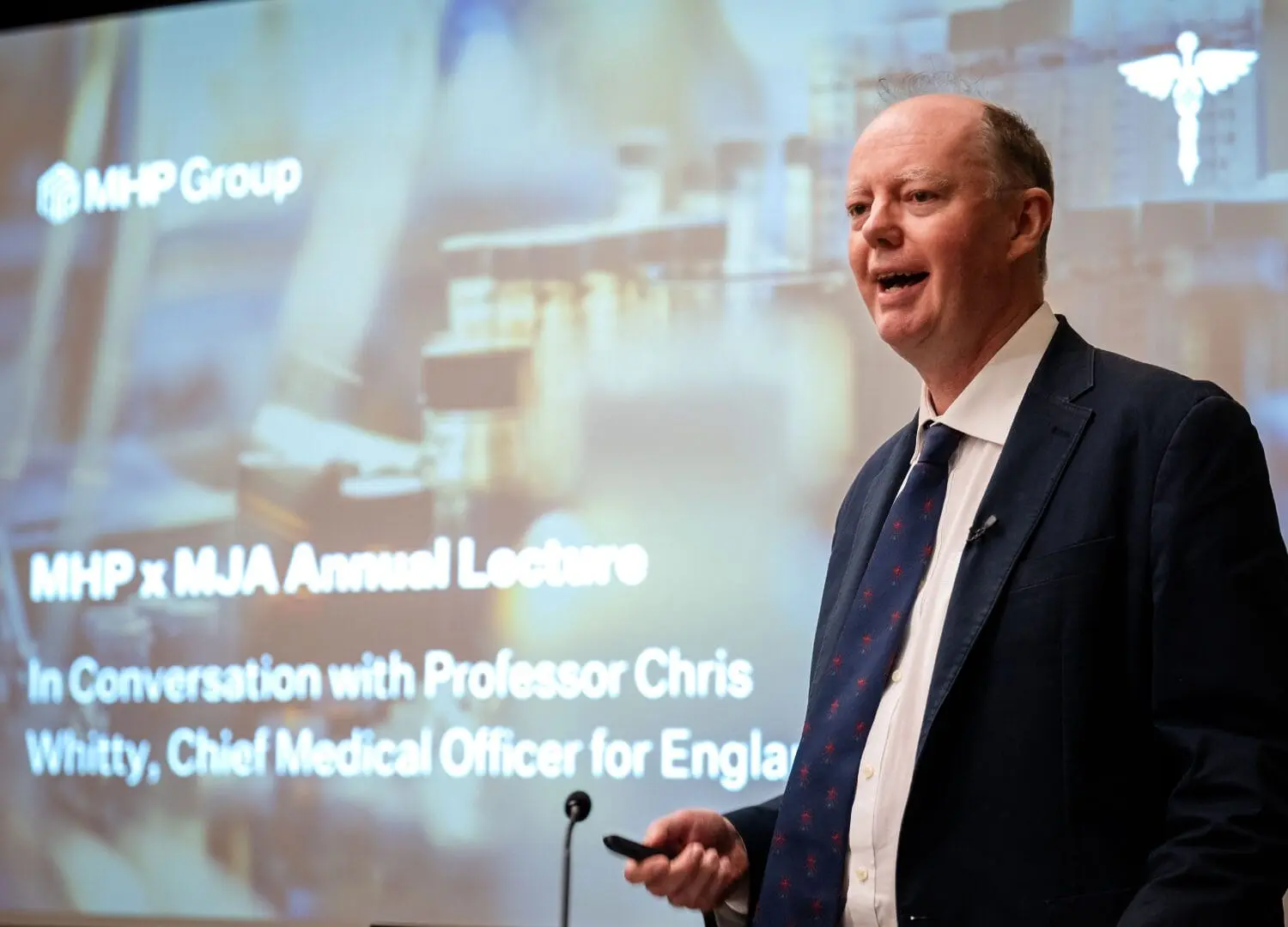 It was very fitting in a room full of some of the top health journalists in the country, that they were able to hear the positive impact they make in shaping the future of health from England’s Chief Medical Officer.
This message was key in Professor Chris Whitty’s opening remarks to the audience which also included health experts across communications, policy and advocacy, at the third annual lecture delivered as part of the partnership between the Medical Journalists’ Association and MHP Group.
Professor Whitty’s lecture shone a light on the key health issues in England and the main drivers behind them of demography, epidemiology, science, economics and politics.
The population is growing older and living with chronic conditions for longer. Geographically, older populations live outside of major cities, often in coastal and rural areas, impacting the burden of ill health and disease.
When it comes to the country more widely, Professor Whitty set out that from a medical point of view there are three main divisions of older age, poverty and youth.
However, this was not a lecture just of doom and gloom, but in fact had a resonating optimistic tone setting out what can be done to address the health concerns, the huge steps science has taken to improve our health outcomes, and the very important role the media has had in driving positive changes.
The country’s health disparities
One of the starkest points Professor Whitty made during the lecture was that people in the most deprived areas of England spend an additional ten years in poor health compared to those in the least deprived areas.
This deprivation has an impact on wider society. People who are living in deprivation have twice the level of frailty of people living in other areas. Living with conditions of frailty for longer makes people feel vulnerable, impacts their independence, takes them out of work, and means they may need additional support from families. It is also likely they’ll need more intervention from healthcare services.
Alongside this is the fact that as people age, the number of chronic conditions they live with increase, and this is something again which is accelerated by deprivation.
Power of prevention
Professor Whitty was clear that the difference in outcomes in more deprived communities is not biologically inevitable, and that better prevention and the mitigation of risk factors is the key to improving them.
Using cardiovascular disease as an example, Professor Whitty highlighted there had been a ‘remarkable downward slide’ in instances over the last 60 years. It is no longer a dominant cause of death as it was in the 1960s. The reasons for this are broken down into three areas; primary prevention – a reduction in smoking being the most significant -, secondary prevention and treatment, as advances in medical science have delivered better outcomes.
Media influence
Professor Whitty outlined that medical journalists heavily influence primary and secondary prevention.
An example of this was around the introduction of the HPV vaccine, which coincided with the reporting of Jane Goody’s story highlighting the dangerous risk of cervical cancer to the public. Levels of HPV are now ‘falling off a cliff’.
When it comes to vaccines more broadly, Professor Whitty said journalists had done a ‘fantastic job’ of helping to explain the side effects compared to risk, with specific mention to the Covid pandemic.
Journalists, including many science and health journalists, have shaped the debate on air pollution, with newspaper campaigns leading to changes which reduced levels of harmful gases.
A particularly remarkable change noted by Professor Whitty has been seen in changes in smoking. Smoking is a key driver in multiple health issues, such as cancer, cardiovascular disease and dementia. But Professor Whitty said the papers and broadcasters had led the way in shaping the debate and making a difference to how the public respond.
For secondary prevention, journalists had been ‘incredibly helpful’ at demystifying new medications and allowing people to understand the power new drugs can have.
More to be done
There are however still areas of health where there is more to be done, and one of Professor Whitty’s biggest worries which he said needs to be taken more seriously is obesity. Compared to the points above on smoking and air pollution which are improving, obesity is in fact going the wrong way. Obesity is not just an issue itself, but also drives cancers, cardiovascular disease, and diabetes. It is an issue again starkly impacted by deprivation, where it is particularly of concern in children. “Nobody should claim that the society does not have some responsibility for the future health of children”, Professor Whitty said.
But it is reversable, with Professor Whitty giving the example of France where obesity rates have improved.
Active participants
Keeping with the optimistic nature of the lecture, Professor Whitty pointed out that in the UK the public is receptive to positive changes, provided they feel they are being given all points of view honestly.
As communicators, we know the role journalists play only too well. We value our relationships with them extremely highly, and know we have trust in them to help us report groundbreaking news and new innovations across the health and pharmaceutical industry, and the benefits these have on wider society.
It was excellent to hear Professor Whitty so resolutely back the important job journalists have, and that they ‘shape the public’s understanding of how health can improve’ by being ‘active participants in the public understanding of science, which if you weren’t writing they would not understand them.’